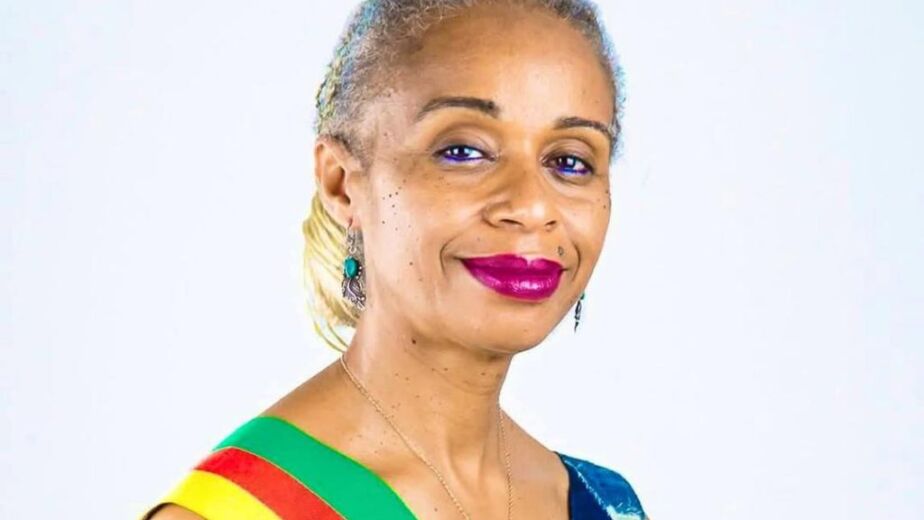
Patricia Tomaino Ndam Njoya is one of the major opposition figures in Cameroon. In a male-dominated environment, the president of the Democratic Union of Cameroon (UDC), a party founded in 1991 by her late husband, imposes her ideas and opinions. Even if it means using strong-arm tactics. Some have described her arrival at the head of the UDC on April 26, 2020, as a “coup de force,” just over a month after the death of her husband, a long-time opponent of President Paul Biya.
Adamou Ndam Njoya’s widow was “unanimously” designated to take over the reins of the party during a meeting of the UDC political bureau in Foumban, the capital of the Noun department in the West region. The appointment was deemed illegal by some party officials, some of whom eventually walked out. This is particularly the case for Christophe Ndeuhela and Cyrille Sam Mbaka, former first vice-president, who is supposed to lead this opposition party until its next convention in 2021, in accordance with the texts that govern it.
But that’s not enough to deter the current mayor of Foumban, who relinquished her seat as deputy to comply with the law prohibiting multiple mandates. Her accession to the presidency of the UDC, which she joined at its inception, delights her supporters, who assure her that she has the makings of a leader. Her opponents, however, see her “succession” as a stranglehold on the party by the Ndam Njoya clan. These considerations do not bother the law graduate, who says she wants to preserve her husband’s political legacy. To date, the UDC holds the executive branch of six of the nine municipalities in Noun and is represented in the National Assembly with four deputies.
Political game
It is clearly to place the UDC at the center of the political game that she joined the opposition platform engaged in “the project of participatory and consensual reform of the electoral system” . She is the only female political leader of this platform which notably includes Maurice Kamto of the Movement for the Renaissance of Cameroon (MRC), Cabral Libii of the Cameroonian Party for National Reconciliation (PCRN) and Joshua Osih of the Social Democratic Front (SDF). The latter came 2nd, 3rd and 4th respectively in the presidential election of October 7, 2018.
Not enough to impress this 55-year-old entrepreneur and writer, whose party achieved one of its worst results in the last presidential election, garnering only 1.73% of the votes cast. Convinced that she is waging a legitimate and necessary fight, Patricia Tomaino Ndam Njoya intrepidly pursues her path, making a few enemies along the way. Her leadership battles with the Sultan-King of the Bamoun are public knowledge. To those who oppose or contradict her, she opposes the law. The sub-prefect of Yaoundé III paid the price in April 2021. This granddaughter of an Italian immigrant managed to force the administrative authority to retreat after it came to ban the opposition’s press conference on the official presentation of the reforms to the Electoral Code, by brandishing the principle of freedom of assembly guaranteed by the Cameroonian Constitution.
Already, when she was a member of parliament, members of the government, mostly from the ruling Cameroon People’s Democratic Movement (CPDM), had a run-in with her when she was secretary of the Commission on Constitutional Laws, Human Rights and Freedoms, Justice, Legislation and Regulations, and Administration at the National Assembly. Patricia Ndam Njoya caused controversy in December 2017 after throwing an easel that accidentally injured a CPDM representative. “We threw easels out of exasperation, because they were being lifted to ask to speak. But in vain. Unfortunately, one of the easels accidentally fell on the face of one of our compatriots. We were very sorry, we apologized to him and thanked God that the accident was not serious, because it could have been serious ,” she later explained. A combativeness that annoys some and commands respect from others.